How much does a bathroom remodel cost?
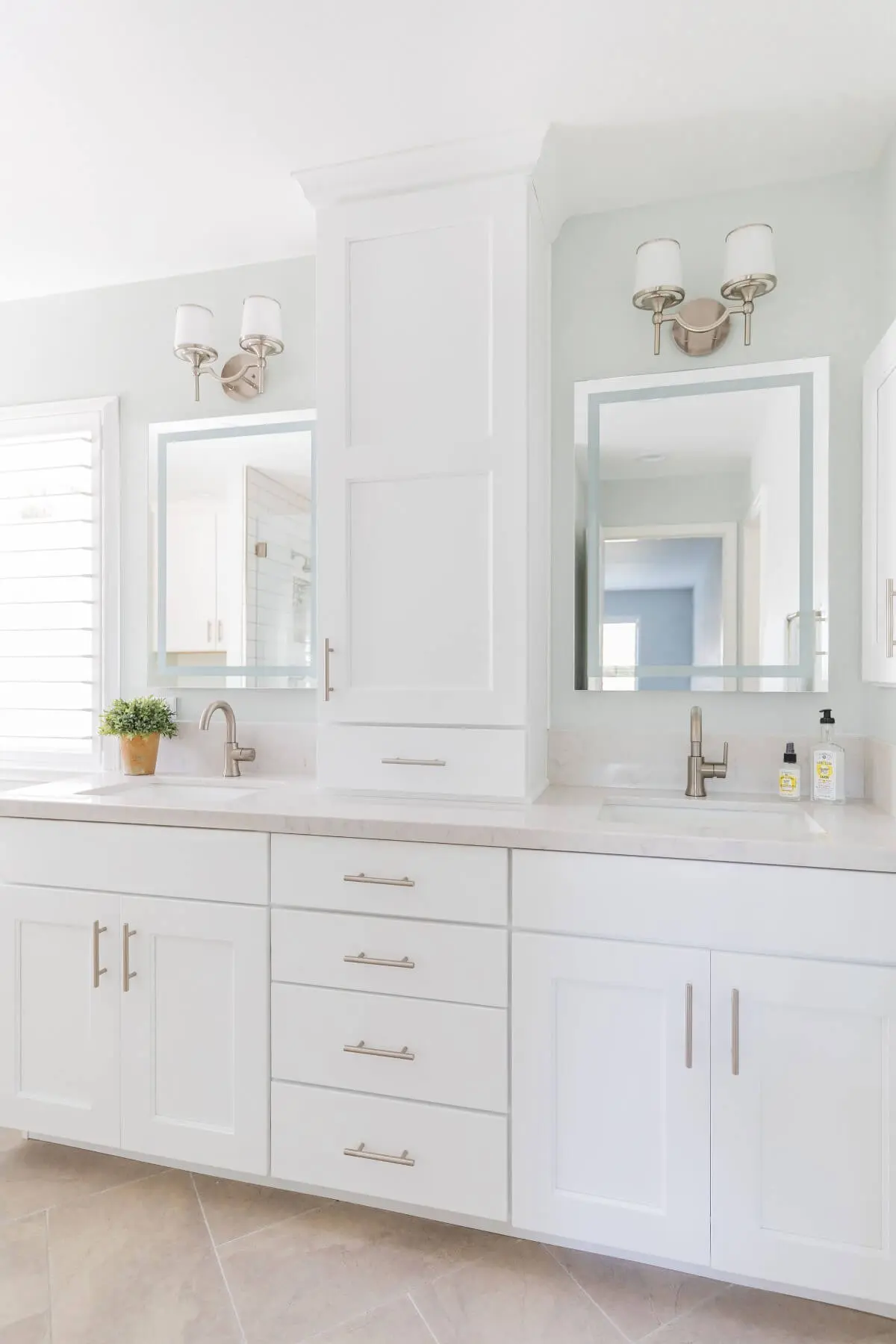
A full and complete overhaul of a typical five-by-eight hall bathroom — the simple rectangle where the door opens and you have a vanity, then the toilet, then the shower — tends to be in the range of $50,000 and above. People do react to that number. We understand why, but that is what these projects tend to cost.
Bathrooms have to be our number one sticker shock item in remodeling, even more so than kitchens. Most people assume a kitchen holds the greatest number of physical parts and pieces. It is one of the more common misconceptions we see.
A bathroom holds every system in the house
For most bathrooms, every system that is in your home is also in that one room:
Flooring, which generally needs to be water resistant and slip resistant — usually tile or another hard surface, and usually a more expensive install.
Cabinetry, countertops and some sort of splash material.
Waterproofing, plus vertical tile or hard surface installations to create waterproof shower walls and surrounds.
Plumbing fixtures and electrical fixtures.
All of the rough systems — rework of electrical, mechanical and ducting, and plumbing, what the industry calls MEP.
The big three nearly always require some sort of modification.
Electrical that no longer meets today's standard
Many homes were wired in a way that does not meet the standard of today's code. Many times we either need to isolate a circuit or bring an additional circuit to the bathroom to protect it appropriately or size it appropriately.
We also often see lights or other electrical items tied into the GFCI-protected circuit. They can be on the circuit. What is not allowed is the lights going off when the GFCI trips.
Ventilation
The old codes allowed a bathroom to have no exhaust fan as long as there was an operable window. When that code came into play decades ago, the idea was that you at least had the ability to vent and provide fresh air and circulation by cracking the window. The reality is that most people do not open a bathroom window regularly for circulation, and you exponentially increase the ability to grow mold or mildew.
So many times we are adding an exhaust fan, or updating the existing one. Most of the old fans had a low enough CFM — cubic feet per minute — that only a three-inch exhaust duct was required, and most of the new ones require a four-inch duct. Sometimes the duct above the bathroom that runs to the roof will need to be replaced as well. That does not always mean getting into roofing as part of a small bathroom remodel, but it is something that needs to be considered.
Glass, and planning for aging in place
Beyond that you have shower glass, which in most of our remodels tends to be some sort of heavy glass or even a frameless system.
We are doing a lot of aging-in-place work — converting old or larger shower curbs to low-threshold or no-threshold floors, also known as zero entry, to minimize the transition between the main bathroom flooring and the shower floor itself. We are doing lots of benches, and installing grab bars or making provisions for them.
Even if you are getting into your 40s or 50s and considering staying in your home long term, it is worth making sure your contractor adds the appropriate lumber backing for grab bars. If you ever want to add them later, you are not trying to locate studs through waterproofed shower walls, or worse, installing directly into the tile. The more that people depend on these bars to support their weight, the more that matters: installed improperly, they can crack tile, break waterproofing membranes and otherwise hurt people. Backing is very important.
It is also worth noting that these products have moved away from looking like typical hospital-grade accessories. Many of the plumbing manufacturers — Delta, Moen, Price Pfister, Hansgrohe — are creating grab bars and other aging-in-place accessories that match the rest of the package: toilet paper holders, towel bars, towel rings, towel hooks, robe hooks. We are also seeing lots of storage options, including lighted medicine cabinets.
Some of these features are not things you have to have. They are worth having. Lighting in particular matters for safety, and as we get older our eyes are not as good, so lighting at the mirror can really help with visibility.
A refresh is a different project
Taking an entire bathroom down to the studs is much different than a surface-level remodel or a refresh, where maybe you are just changing tops or trying to salvage your bathtub.
We are usually of the mindset that when you are removing tile above a bathtub that has been there for 30 or 40 years, the tub may be in good condition, but this is the one opportunity you may ever have to remove it and put in something new. The same is true of cabinets. When you are spending hundreds or thousands of dollars on new countertops, sinks and fixtures, those items inevitably trap the cabinet from being replaced. It is not realistic to think you will put all of that money on top of your cabinet and then pull it out five years from now.
That leaves one option, which is to reface or repaint. Painting, staining or adding a clear coat in place can be invasive and can not smell great. It can absolutely be done, but if it is not done professionally it is not likely to last very long, especially in a wet or damp environment like a bathroom. The internal structure of the cabinet is usually some sort of plywood material, and over time the moisture content in a bathroom takes its toll on those components — sometimes they are breaking down in ways that are not visual.
Refacing has its place. But a single vanity that has no countertop on it for even one day seems like a silly thing to try to salvage when it is very easy to remove and replace at that moment.
Phasing, and the cost of mobilization
You can phase a project so that it is not a $50,000 hit all at one time. With a refresh you can split it into multiple projects as well — the floor and baseboards this year, the shower as a separate project next year. That is a much different way to approach a project that has some parts that need to be done now and some that can wait.
Phasing with a contractor is generally the more expensive way to do it, because a contractor's costs come in what we call mobilization. Internally we joke about the get-out-of-bed fee. A tile contractor may be willing to do a very small project while he is already at the house working on something else. As a standalone project, maybe $500 is not enough to make him want to wake up, roll out all of his tools, do that small project, roll up his tools, clean everything and put it all back. That is really where multiple small projects can be bundled together, and usually there is money to be saved, because you are not asking for multiple trips from the same subcontractor.
When it makes sense to hire a general contractor
We generally focus on the full-scale remodel over the refresh. Most refreshes, especially in a small hall bathroom, can be done by a homeowner, or the homeowner can hire a single subcontractor directly and work with them on that one task.
When the subcontractor list grows to three or four or more — and especially on large-scale primary bathroom remodels, which tend to be sometimes as much as double a hall bathroom cost or more depending on size, complexity, the count of physical pieces and features like steam units — that is when we want to see people hiring a professional contracting company. That is what makes sure all of the finishes come together correctly, that every subcontractor understands the finish level expected, and that the trades overlap so each one sets up the next correctly.
It is not impossible to do on your own, but without long-term experience it is not likely to come out with the level of detail that somebody who does this all the time can achieve. Subcontractors can also be very difficult to manage and keep on task, and a general contractor doing this every day has a much better pulse on who needs to be where and when, and on providing the appropriate reminders to those who are not as good with time as others.
If you want to talk it through
If you want to know what a full remodel would take, or just what the best way to approach your project might be, book a discovery call with us.
We will never push you toward something you are not already wanting to do. We are not going to push you into a $20,000 steam unit when that is not what you want. It also does not matter to us whether someone spends $50,000 in a bathroom or $500,000. The margins are exactly the same on both. The difference is that we are on the $50,000 project ten times less than the $500,000 project. It is all a metric of time, so small project or big project is irrelevant to us. We want to help people go in the right direction, plan for both now and the future in the items they pick, set up for aging in place if they intend to stay long term, improve function, and get everything to code.