Why won't a contractor give me a price over the phone?
Asking a contractor for a price over the phone is very similar to asking a dealer for the price of a car when he has no idea what make or model you want. On a building project at your home, it is impossible for me to know what your house looks like, what the existing systems are, what might be in the way, what might be easy, what might be typical, what might be extremely difficult, and what may need structural modifications in order to make any of it work.
The two kinds of calls
I have been answering these phone calls for more than twenty years, and there are generally two types of people calling. The first genuinely just wants to hear a number so they can move on to the next phone call and find out whether the number lands somewhere near what they were hoping. The second feels they need to provide every detail possible on the call, because they believe that if they give enough information the contractor will have enough of a picture to start offering pricing ranges.
I don't get upset with people who ask, directly or indirectly. It feels like a very fair question. And to be honest, if someone's number is significantly lower than what the project could ever be valued at, I want to help us get through the conversation quickly, because I already know we can't help.
The tough part is that contractors genuinely don't know what a project is going to cost. Not over the phone, and not with a few pictures and some additional information either.
What you'll actually get if you push for a number
You'll get one of two things, depending on who you call.
A contractor with a more traditional approach may simply give you a lowball number — the lowest figure he knows he could possibly do a project for. It's a line in the sand. Anyone who reacts badly to the lowest number gets let go, which is a faster version of what I'm trying to do in a longer conversation, and it puts him in front of more people. Getting in front of more people is ultimately what takes a contractor away from the clients who are already paying him to build their projects. That's the other reason I don't want to waste time on the phone: time I'm not using efficiently is time I can't put into clients who are already paying our company to work with them through preconstruction or to build their work.
If I'm pushed into giving a range, my range isn't structurally much different from that low number offered to get a foot in the door. It would be my lowest project cost of a similar scope over the last one to two years, and my highest project cost of a similar scope over that same period. All that tells you is that we have done projects within that range, and that sight unseen I would guess yours falls somewhere inside it. The low end was probably simpler, more cut and dry, with fewer modifications to the structure. The high end was the opposite — major modifications, significant upgrades in materials, changes to systems, structural work.
Two identical floor plans, one nearly double the other
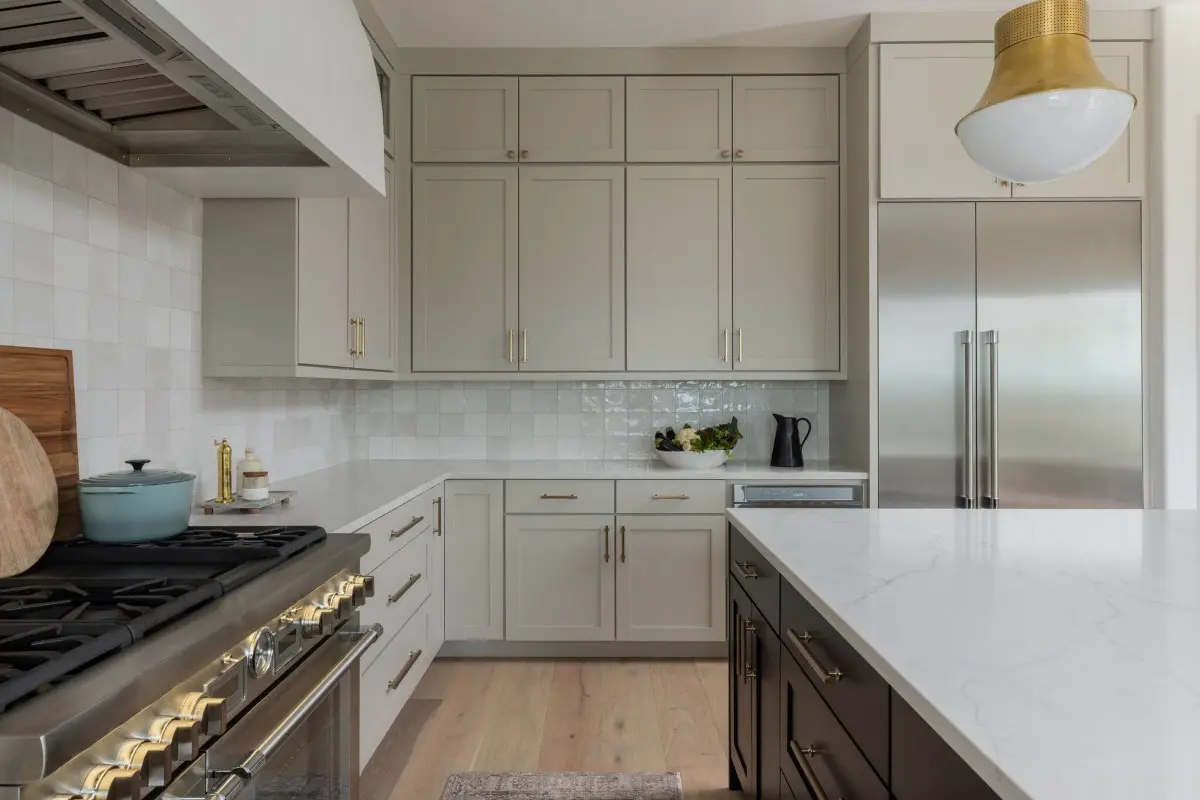
No two projects are the same. We have built kitchens for next-door neighbors with the same floor plan in a tract build, and one was nearly double the other.
Most people assume the difference was finishes. That does happen. But in this case the difference was scope. The larger project included a wall removal and a modification to the structure, which made the kitchen's footprint bigger. We were able to extend cabinetry into another area and build a large island, which added physical material to the job. Flooring was also in their scope, and the flooring carried into the other common areas of the home — the hallways, entry, family room and kitchen all ended up on the same material.
Scope rarely stays in the room it started in
A client may call about a kitchen with a genuinely realistic budget for the kitchen itself, confined to the work inside that room. Then we start factoring in the flooring, the baseboard that comes with the flooring, and the painting. Kitchens are by far the number one example of this. The kitchen is the core of the project, but once flooring enters the conversation the actual area of work expands well past it.
In roughly 80 to 90 percent of the scenarios where we're doing flooring, people want to completely repaint the rooms we're in, because the rooms are already empty. There's a mental shift — everything is already out, we might as well paint. Most people spending this kind of money will spend a few thousand dollars more to paint the spaces and have them all fresh while they're empty and while we may already be painting baseboards.
These are not things we tell our clients. We don't bring a project to a client and tell them how it should be. The client is the one bringing the project to us and shaping the scope. We may ask whether they'd like a room painted, but whether they do isn't something I need them to decide one way.
They are also the things nobody is thinking about on that first phone call. When you're talking about your kitchen, you're not thinking about painting the family room, putting baseboard in the living room, or replacing the outlets and switches in the hallway. Then we dig in, and the client realizes the kitchen is going to look fantastic and the room right next to it is not going to match. So the flooring runs in there, and it gets painted, and the switches and outlets get replaced, and maybe the light fixture, and maybe the can light trims go from old incandescent to LED — and that room has effectively been remodeled too.
The other thing people don't realize is that most rooms outside of kitchens and bathrooms are four walls, flooring, paint and a small amount of trim, doors and millwork. There aren't many systems in a family room or a bedroom or a hallway. And people don't want hard lines between a remodeled space and one that isn't. Nobody wants to spend money on a kitchen and then have guests walk two steps into the family room and feel how old and dated it is.
Competitively interview instead of competitively bid
I caution people against chasing numbers over the phone and suggest spending that time on an interview instead. If you've read anything I've written or listened to our podcast, you've heard me say it: don't competitive bid, competitive interview.
A good contractor will treat you right, point you in the right direction, charge you the right price from the very beginning, and help you figure out what that right price is. The less organized ones tell you everything you want to hear at the start and then take you through the grind you've heard the horror stories about — the ones where numbers change and people don't do what they said they'd do. The main reason that happens is that most contractors don't know how to sell preconstruction services. They're afraid to lose a project that may not even be a good fit, rather than explain to a client that paying for that expertise and that process is worth every penny.
Years in business is not the only marker. We know people five years in running a very similar process, and if they've perfected their preconstruction, do good work and have good reviews, that's probably somebody you'd want to work with.
A number over the phone isn't realistic in either direction. You may hear one that sounds good and get excited, and it may not be real. You may hear one you didn't want to hear and get frustrated early, and the person on the other end may not actually know and may be overbidding it. We'd rather wait until we've had the chance to work with someone and say: here is a realistic idea of what we think the cost range is if you do A, B and C.
A real preconstruction process can also open up options — changes to scope, or products that don't significantly affect the design but do affect cost. I'm not suggesting every client needs to find savings. But most clients who come to us have a wish list that exceeds what their budget can truly afford, so small sacrifices are generally made on most projects.
Nearly every wish list exceeds its budget
A client may have chosen a scope and chosen a budget without doing the homework that connects the two. Those two numbers can be wildly different. In twenty years I'd say about 99 percent of the people who come to us have a wish list that exceeds their intended budget. I think it's something we do inherently as humans — we want certain things, we hope to pay a certain price, and hope is what it is.
When the scope is bigger than the budget affords, there are two moves: increase the budget to reach the vision, or bring the vision down to meet the budget. None of that can happen over the phone. All of it takes time, and all of it is part of the preconstruction process.
So interview your contractors. Ask about their process. Ask about their timing. Ask what they do when there's a problem. We have resources on our website that are completely free — download them and ask the questions. After two or three conversations or in-person meetings, you'll know who gives you a good feeling, who you're comfortable with, and who you can communicate with. Those are the most important things. Cost up front shouldn't be, though of course you need to know you can afford the work at some level.
And when a contractor tells you your budget sounds realistic, that doesn't mean it's realistic for the whole wish list. It means you likely have a budget that should be able to afford you a project. Then it's time to sit down and figure out exactly what that means — what you can do, what materials you can afford, and whether the scope needs to come up or come down.